|
You have tried all the Draino etc. cleaners, picked
hair out of the drain and flushed water down the tub drain and it
still drains slowly. What next? Well, there is a little known
feature of most tubs that causes most blocked drain symptoms. It
is the "stopper" that is used to make the water stay in
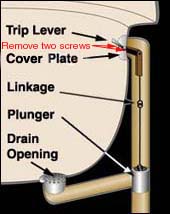
the tub or drain out. It is a small lever at the plumbing end of
the tub that is usually mounted in a plate attached to the tub
with two screws.
You need to remove the two screws that hold that plate
onto the tub, then pull the whole assembly up and out. You may
have to finagle it a bit to get it out but when you finally do
there will be a brass cylinder at the end of a long wire pull
rod. If there was water in the tub it should all drain away at
this time. It will be covered with schmutz, hair, soap scum and
everything else it can catch. It is probably a haven for bacteria
so I would suggest that you might want to either use rubber
gloves or soak it in a Clorox solution for a few minutes to
disinfect it! If you can do so without puking, just pull all of
that stuff off and reinsert the assembly back down into the tub.
Replace the screws and you should be back in the quick drain
mode. If
that doesn't work, call a Los
Angeles plumber for
help since you're in that area.

Update
- I received a letter from a reader who had this story to add:
Dear
Bob,
For
two days our tub and sink have been extremely slow draining.
As of yesterday afternoon it had stopped draining altogether.
I tried everything including dumping a $13 bottle of Drano into
the tub and sink, plunging furiously for two hours and cutting a
piece of garden hose, sticking it down the drain and blowing on
it till I was dizzy. Being a stubborn German girl who
prides herself in being able to fix almost anything herself,
I still was not ready to call a plumber in (although my husband
and teenage boys were more than ready to make that call).
This
afternoon I googled clogged tubs and your site was the first I
noticed. I read the advice on removing the trip lever and
cover plate. Excitedly I ran up the stairs with my
screwdriver in hand. I removed the plate and stopper
and waited for something to happen. Nothing.
Unfortunately my clog seemed to be a little deeper than the
stopper. Although this wasn't my solution, your advice
still saved my day...and my pocketbook.
With
the cover off, I tried plunging again. All of the water
was now being pushed out of the hole where the cover
plate was. This gave me the idea that I need more air
pressure in the pipes. I pushed a rag into the cover
plate hole, covered that with plastic and had my 16 year old
son hold his hand over it while I did some more plunging.
Now I was getting more pressure, but the air seemed to be coming
out of the sink drain now. I covered the sink
drain and the overflow drain with plastic and had my 14 year
old son put his hands over them and apply pressure.
Now, with our three man circus, I started plunging again.
We had the pressure we needed and after about one minute we heard
the glorious sound of water draining. It drained
quickly just as it is supposed to.
So,
had I not found your site and your advice, I never would
have thought to remove that cover plate and in turn would not
have come to the conclusion that I needed to apply pressure
to all air escapes. Thank you for this wonderful site
you have created. I will certainly put you on my favorites
list and am going to look into those manuals because I too have a
walking washing machine.
Sincerely,
Stephanie
Back to Brother
Bob's Home Page
Copyright © 1996 - 2005 by Bob Hewitt - All rights
reserved
|